Your body cannot heal in a state of hurry. Beneath the noise of modern life, your nervous system is waiting for one simple signal: safety. Stillness is how you send it. And inside that signal, real repair begins.
The Quiet State Our Bodies Are Missing
There’s a moment most of us know too well. The day isn’t even half over, and your shoulders are already climbing toward your ears. Your jaw feels tight. Your thoughts are racing ahead of your body. You’re answering messages while eating, planning tomorrow while standing in today, pushing through because slowing down feels impossible. Nothing dramatic is happening. No crisis. No emergency. Just the steady, quiet hum of pressure that never fully shuts off.
This is modern life for many of us. Always on. Always braced. Always one notification away from the next demand. Our bodies were never designed for this kind of long-term intensity. They were designed for short bursts of stress followed by long stretches of recovery. Instead, we live in a state of low-grade emergency that never ends. And over time, it changes us.The Body That Never Feels Safe
Here’s the part that rarely gets talked about in everyday health conversations. Your nervous system is not just reacting to your life. It is shaping it.
When stress becomes constant, your body shifts into a survival mode designed for short-term danger. Heart rate rises. Breathing becomes shallow. Muscles tighten. Digestion slows. Hormones shift. Your system becomes brilliant at one thing: getting you through.
But it is not designed to live there.
This is the same biological pattern behind so many chronic struggles we now accept as normal. Exhaustion that never lifts. Sleep that never feels deep. Anxiety that sits just under the surface. Inflammation that won’t calm down. If you’ve ever felt like your body is stuck in “on” mode, you’re not imagining it.
We’ve explored how modern life quietly keeps us in survival mode before, especially in this piece on how environmental pressures disrupt our internal balance:
Rebalancing the Hormones No One Talks About
And when the land itself becomes depleted, we see the same pattern mirrored in nature. Constant extraction without restoration leads to collapse. The same is true for our bodies: When the Land Is Tired, So Are We
Stillness Is a Biological Switch
Stillness is not laziness. It is biology.
It is the signal that tells your nervous system, “You are safe now.” When safety is sensed, the body repairs. Inflammation lowers. Digestion returns. Sleep deepens. Hormones rebalance. Immune function strengthens. Emotional regulation improves.
None of this happens in high gear. Healing lives in the quiet.
Slowness is where the body does its real work.
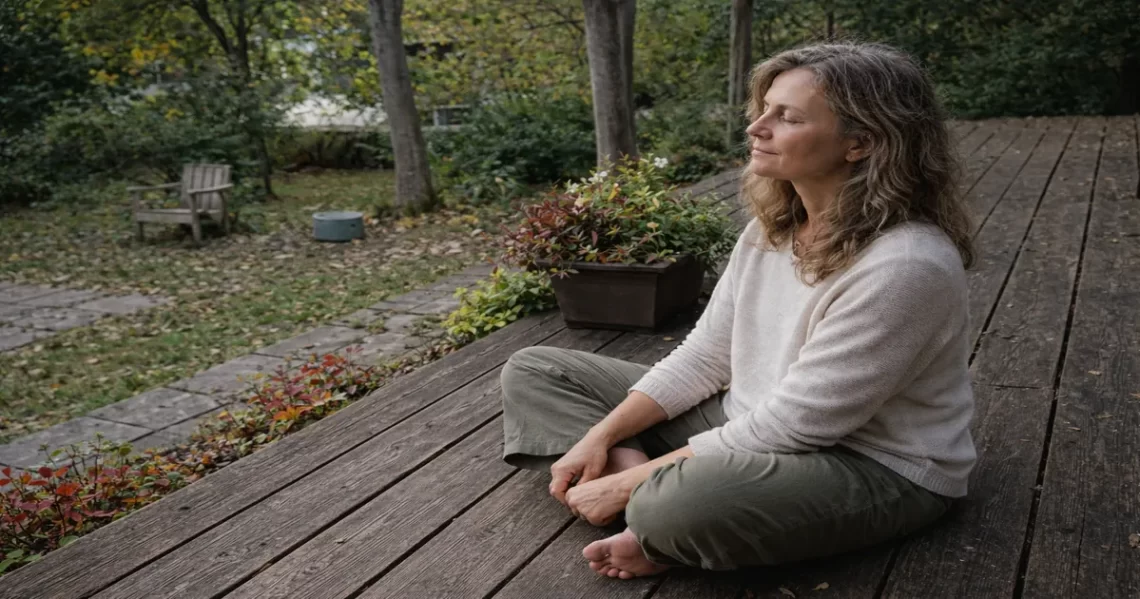
This is why practices that look simple on the surface have such profound effects. Sitting quietly with your feet on the ground. Taking slow breaths that reach your belly. Walking without a destination. Lying down without scrolling. Letting silence exist without filling it.
These are not self-care trends. These are nervous system instructions.
When We Override Rest, We Override Repair
The modern world trains us to override these signals. We drink caffeine to push past fatigue. We scroll to avoid stillness. We stay busy to avoid feeling. We treat rest as something earned instead of something required.
And then we wonder why anxiety rises, sleep disappears, digestion struggles, autoimmune issues grow, hormones wobble, and exhaustion becomes normal.
Here’s the warning that matters.
If you never give your body safety, it will never fully heal.
You can take supplements. You can eat well. You can exercise. But if your nervous system stays locked in chronic stress mode, those efforts will always be swimming upstream. The body cannot repair in a state of threat. No matter how subtle that threat feels.
This is why so many people feel like they’re doing “all the right things” and still not getting better. The missing piece is often not another protocol. It is permission to slow down.
An Invitation Back to Yourself
And this is where I want to offer an invitation, not a command.
You don’t need a retreat. You don’t need an hour of meditation. You don’t need to overhaul your life overnight. You need small pockets of stillness woven into ordinary days.
One slow breath before you stand up.
One meal eaten without multitasking.
Five minutes of sitting outside.
A pause before reacting.
A moment of doing nothing at all.
These tiny acts retrain your nervous system. They remind your body that safety exists. Over time, that safety becomes easier to access. Your body softens. Your mind quiets. Your resilience grows. Not because you forced it, but because you finally gave it space.
Stillness is not the absence of progress. It is the foundation of it.
And in a world that keeps asking you to speed up, choosing slowness may be one of the most healing decisions you ever make.
With love and truth,
—Donna 💚
Sources & Further Reading
The biology of stress, nervous system regulation, and sleep’s role in recovery is well documented. If you’d like to explore the science more deeply, these are reliable, readable sources:
Polyvagal theory and nervous system safety states (peer-reviewed overview)
https://pmc.ncbi.nlm.nih.gov/articles/PMC9131189/
How sleep works and why it matters for physical recovery
https://www.sleepfoundation.org/how-sleep-works
How sleep supports physical health and system repair
https://www.sleepfoundation.org/physical-health
CDC overview of why sleep matters for health and recovery
https://www.cdc.gov/sleep/about/index.html