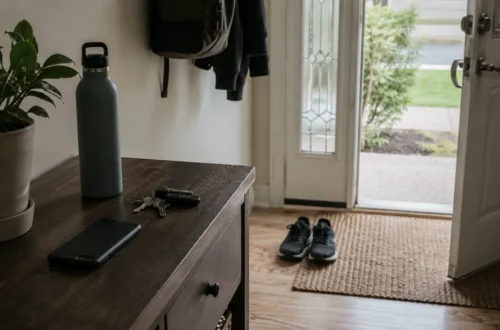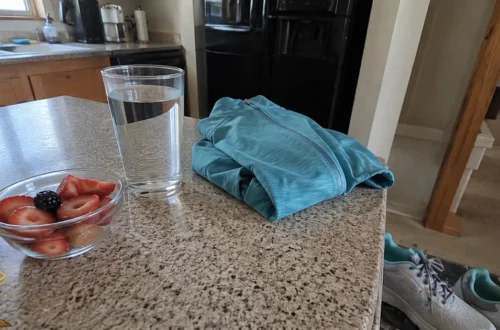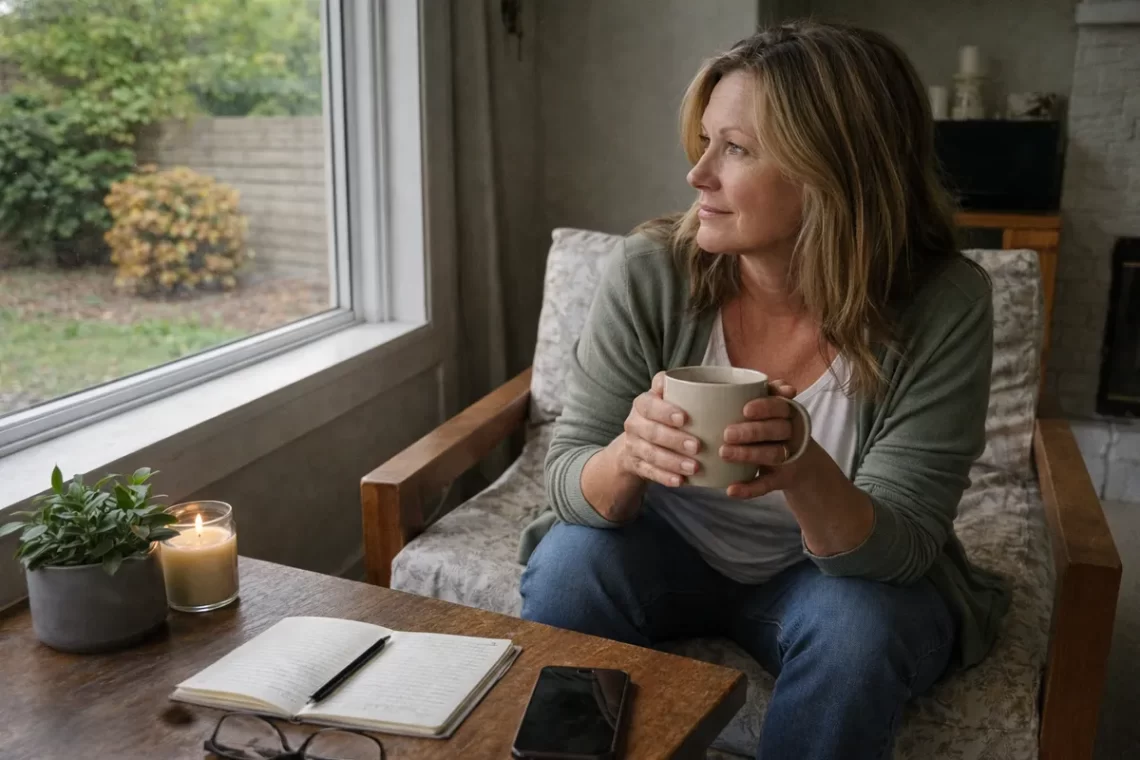
If you’ve felt “wired but tired,” scattered, tense, or like your body never fully unclenches anymore, this is for you. Presence isn’t a luxury. It’s a lifeline.
Lost in the Glow
There was a time when being “busy” meant doing something tangible. Folding laundry. Chopping vegetables. Sitting in a chair talking to someone face to face. Now busy looks like staring at a glowing rectangle while your shoulders creep toward your ears, your jaw locks, and your breathing gets so shallow you barely notice you’re doing it.
You might be answering messages, reading headlines, scrolling updates, or researching something important. And yet somehow, your body feels like it’s bracing for impact. I hear women say things like “I can’t relax” or “My mind never shuts off.” And almost always, the body is sending the same message: you’re not here.
You’re hovering a few inches above yourself, living from the neck up, operating in quiet survival mode while life rushes past your peripheral vision.Presence Is a Physical Act
This is the part no one teaches us. Your nervous system doesn’t know the difference between a real emergency and a constant stream of stimulation. When your attention is scattered, your body tightens. When your body tightens, your breathing shortens. When your breathing shortens, your brain interprets danger.
And suddenly you’re living your life from a state of low-grade alarm without even realizing that’s what’s happening.
Presence is not some lofty concept. It’s physical. It’s your feet on the floor. Your breath moving your ribs. The feeling of your hands. The sound in the room that isn’t coming from a device.
When you return to your body, even briefly, your nervous system gets a message it hasn’t received in a long time: “You’re safe enough right now.”
If you want a deeper foundation for this, read this Why Wednesday post: Why the Nervous System Isn’t the Side Show — It’s the Main Event. It explains (in plain language) why your system reacts the way it does when life gets loud.
Small Practices That Bring You Back
I’m not talking about a perfect morning routine. I’m talking about tiny moments you can actually do. Real life moments.
1) The long exhale. Breathe out a little longer than you breathe in. You don’t need a method. You just need a slower exit. Your body understands that signal.
2) The “name what’s here” reset. Look around and name five things you can see. Four things you can feel. Three things you can hear. Two things you can smell. One thing you can taste. It sounds simple because it is simple. And that’s the point.
3) The shoulders-down cue. Drop your shoulders. Unclench your jaw. Feel your tongue resting in your mouth. It’s amazing how often we’re gripping for no reason.
4) One real minute. Put your phone down and stare out a window for sixty seconds. Not as a productivity trick. As a reminder to your body that you are not being hunted.
And if you want a MAHA Monday companion piece that’s in this same lane, this one pairs beautifully: Healing the Body When the World Feels Loud.
Disconnection Turns Painful
Here’s the warning. If we normalize disconnection, the body will eventually raise the volume.
Anxiety. Insomnia. Chronic tension. Emotional reactivity. Digestive issues. Numbness. None of these appear out of nowhere. They’re often the body’s final attempt to get your attention after years of being politely ignored.
And the world we’re living in right now? It rewards disconnection. It rewards speed. It rewards constant input. It rewards never being alone with yourself long enough to feel what you actually feel.
But your body cannot live like that forever. At some point, it will demand to be heard.
Come Home (Gently)
The good news is presence doesn’t require a retreat, a perfect mindset, or an hour of meditation. It starts small.
A hand on your chest while you breathe for ten slow counts. Feeling your feet press into the floor before you stand up. Taking one sip of water and actually tasting it. These are not trivial actions. They are signals.
They tell your body: “I’m listening now.”
So today, don’t try to fix everything. Just notice when you’ve disappeared from yourself, and then return. No judgment. No performance. No forcing. Just a quiet coming home, again and again, in ordinary moments.
Over time, those moments stack. And slowly, subtly, your body learns that life is not something to brace against.
It’s something you’re allowed to be present for.
With love and truth,
—Donna 💚
Sources & Studies Mentioned
Harvard Health Publishing. “Breath control helps quell errant stress response.” (Updated July 24, 2024)
https://www.health.harvard.edu/mind-and-mood/relaxation-techniques-breath-control-helps-quell-errant-stress-response
Cleveland Clinic. “13 Grounding Techniques To Help Calm Anxiety.” (Nov 25, 2024)
https://health.clevelandclinic.org/grounding-techniques
Balban MY, et al. “Brief structured respiration practices enhance mood and reduce physiological arousal.” Cell Reports Medicine. (2023)
https://pmc.ncbi.nlm.nih.gov/articles/PMC9873947/
Mayo Clinic. “Mindfulness exercises.” (Ongoing clinical resource; publicly accessible)
https://www.mayoclinic.org/healthy-lifestyle/consumer-health/in-depth/mindfulness-exercises/art-20046356
Bentley TGK, et al. “Breathing Practices for Stress and Anxiety Reduction.” (2023)
https://pmc.ncbi.nlm.nih.gov/articles/PMC10741869/