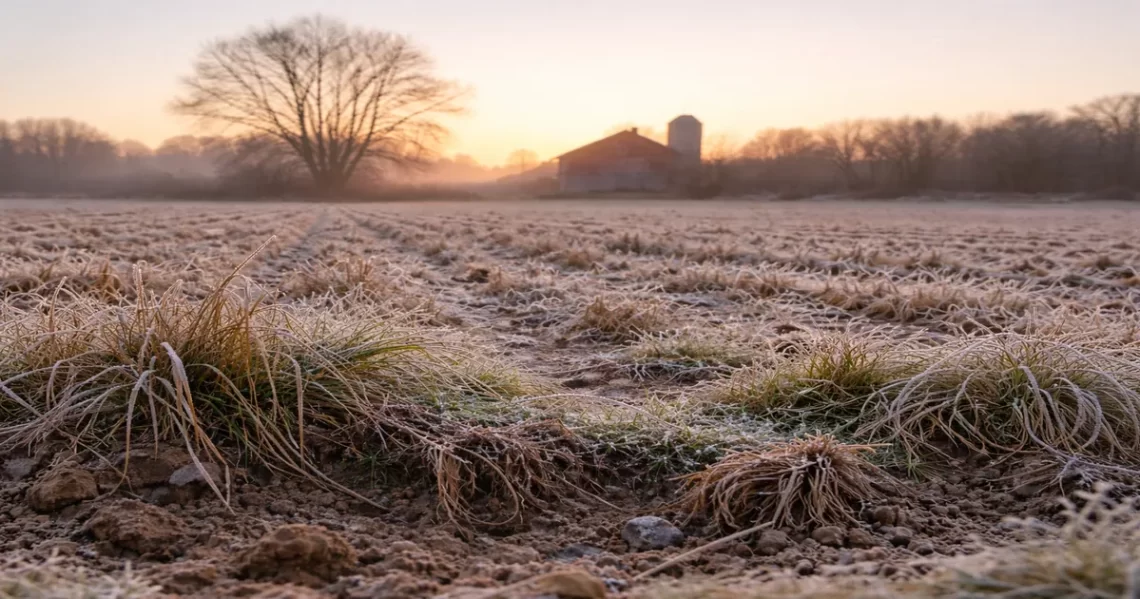
If we were sitting together over coffee, watching frost lift slowly off a field, I’d probably say this first. Winter gets misunderstood.
We’re taught to see it as bleak or unproductive, something to get through so real life can start again. But the land tells a different story. Fields go quiet. Trees stand bare. Everything pulls inward. And if you don’t know what you’re looking at, it can seem like nothing is happening at all.
But farmers know better. So does the soil.
Winter isn’t a season of loss. It’s a season of getting ready.
What the Land Is Doing When Nothing Looks Busy
In winter, plants draw their energy down into their roots. Soil life slows, but it doesn’t disappear. Fungi, bacteria, and microbes continue their quiet work, responding to freeze-thaw cycles, reorganizing nutrients, and laying the groundwork for what comes next.
Life doesn’t stop. It becomes less visible.
That idea doesn’t sit well in a culture obsessed with constant motion. We’ve been conditioned to believe that if we’re not producing, optimizing, or growing outward, we’re falling behind. The land doesn’t operate that way, and it never has.
Without winter, there is no spring worth trusting.
Endurance Isn’t Loud
We tend to imagine endurance as grit, hustle, and pushing through. Nature offers a quieter definition.
A field left fallow isn’t abandoned. It’s recovering. A tree without leaves isn’t weak. It’s conserving. A farmer sitting at the kitchen table in January, coffee cooling beside a stack of seed catalogs, isn’t idle. They’re paying attention.
Real endurance knows when to pause. It understands that rest isn’t failure, it’s strategy.
This same truth shows up again and again in regenerative systems. We’ve talked before about why regenerative farms grow more than food. They grow resilience because they respect cycles instead of fighting them.
Winter Forces Honesty
Winter has a way of stripping away illusions.
There’s no hiding from depleted soil when growth slows. No pretending that shortcuts didn’t take their toll. This is the season when farmers look back honestly at what worked and what didn’t. Soil tests are reviewed. Rotations are reconsidered. Mistakes are acknowledged without drama.
Industrial systems don’t allow space for this kind of reflection. They demand constant output, no matter the cost. Regenerative farming depends on the opposite. Renewal requires restraint.
If you don’t slow down long enough to listen, you carry the same problems forward. And the land always keeps score.
Roots Come Before Results
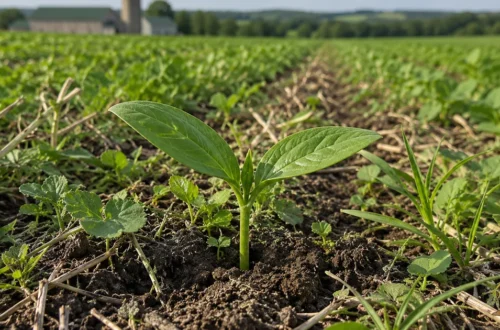
Strong harvests don’t start above ground. They start below it.
Deep root systems improve soil structure, increase water retention, protect against erosion, and support microbial life that feeds plants naturally. These roots are what allow farms to withstand drought, erratic weather, and economic pressure. They’re the quiet difference between systems that survive hard years and systems that collapse under stress.
This isn’t just a farming lesson. It applies to communities, families, and food systems too. Shallow systems may look productive for a while, but they crack under pressure. Deeply rooted ones bend, adapt, and endure.
We see this clearly when soil is treated as a living system instead of a growing medium, a theme explored further in conversations about soil health and food resilience, including how soil degradation shows up on our plates.
Renewal Can’t Be Forced
You can’t rush renewal, and you can’t engineer it on demand.
The land doesn’t respond to deadlines. It responds to care. That means allowing rest. It means easing off practices that exhaust soil life just to squeeze out one more season. It means recognizing that nature isn’t something to dominate, but something to work with.
Winter makes this impossible to ignore. Renewal comes when conditions are right, not when impatience demands it.
Carrying This Into the Year Ahead
As the year ahead begins to take shape, the land offers a simple invitation.
Slow down enough to notice what needs strengthening beneath the surface. Tend to roots before chasing results. Let rest be part of the plan, not something you feel the need to justify.
Because resilience isn’t built during the loud seasons. It’s built in the quiet ones.
Spring will come. It always does. What it brings depends on how well we honored winter.
With love and truth,
—Donna 💚
Sources & Studies for Further Reading
Winter soil microbial resilience
Research showing that soil microbes remain active during winter and respond to freeze-thaw cycles, influencing nutrient cycling and soil function.
https://doi.org/10.1016/j.soilbio.2021.108499
Freeze–thaw cycles and soil nutrient dynamics
Study examining how seasonal freeze–thaw patterns affect microbial activity and nutrient availability in soils.
https://www.sciencedirect.com/science/article/pii/S2351989420309768
Soil carbon sequestration and regenerative practices
Rodale Institute white paper summarizing how living roots, crop diversity, and regenerative practices build soil carbon and resilience.
https://rodaleinstitute.org/wp-content/uploads/Rodale-Soil-Carbon-White-Paper_v11-compressed.pdf
Freeze–thaw impacts on soil ecosystems
Open-access research on how winter temperature fluctuations influence microbial processes and soil cycling.
https://www.frontiersin.org/journals/forests-and-global-change/articles/10.3389/ffgc.2022.800335/full