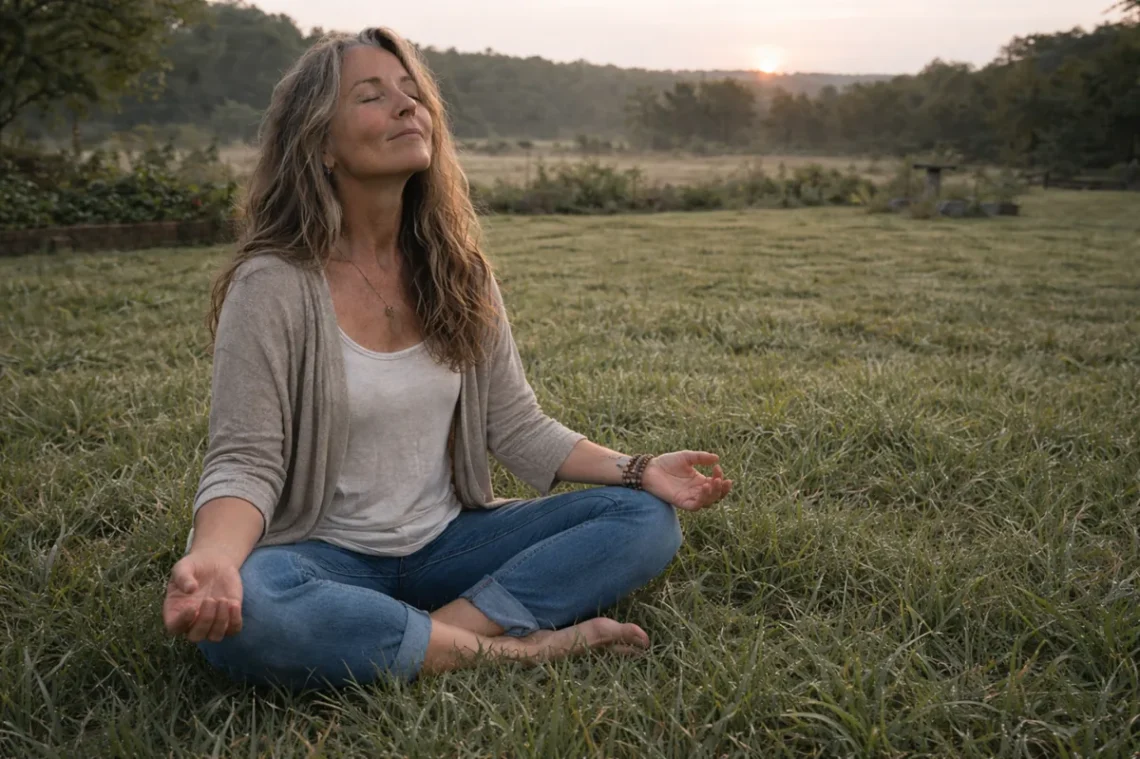
For a long time, many of us were taught that health comes from outside of us. From test results. From experts. From treatment plans written by someone who barely knows our story.
Medicine absolutely has its place. But I believe something important has been lost along the way. We have slowly been trained to distrust the signals of our own bodies.
Instead of listening inward, we look outward. Instead of asking “What is my body trying to tell me?” we ask “Who will tell me what this means?” The more I watch this pattern unfold, the clearer it becomes that many people are living in survival mode, but very few have been taught how to return to sensing mode.
And I keep coming back to this thought: that shift — from surviving to sensing — may be one of the most powerful forms of health literacy we can reclaim.
Why So Many People No Longer Trust Their Own Bodies
This disconnection didn’t appear overnight. For decades, health culture has slowly conditioned people to override their internal signals. When you are tired, you are told to push through. When stress builds, you are told that’s simply part of modern life. When pain appears, the immediate response is often to suppress it rather than understand it.
Over time, this constant overriding creates a quiet disconnection between the brain and the body. What concerns me most is how early this pattern starts. Children naturally listen to their bodies. They rest when they are tired, eat when they are hungry, and pull away from things that don’t feel right. But adulthood often replaces that instinct with rules, schedules, and external expectations.
Schedules replace rhythms. Protocols replace awareness. Authority replaces intuition.
I cannot ignore the consequences of that shift. Eventually many people stop asking the most important question of all: What is my body actually telling me right now?
If we are going to rebuild health sovereignty, reconnecting with our internal signals is not optional. I truly believe it is foundational.
What Health Intuition Actually Is (And What It Isn’t)
The word intuition sometimes makes people uncomfortable because it sounds mystical or vague. But the more I study how the body actually functions, the more obvious it becomes that intuition is not mystical at all.
It is biological.
Your nervous system is constantly gathering signals from inside the body — hormone fluctuations, inflammation markers, blood sugar changes, hydration status, stress chemistry, immune responses, and countless other feedback loops. Many of these signals appear long before lab values shift or symptoms reach the point where they demand medical attention.
I am continually surprised by how often people dismiss these early signals, even when their body is trying very hard to get their attention.
The pattern becomes impossible to overlook once you begin paying attention. The body almost always whispers before it shouts.
That’s why so many people later say things like, “I knew something wasn’t right,” or “I wish I had listened sooner.” I hear that story again and again.
And it always leads me back to the same realization: your body is always communicating.
The real question is whether we have been taught to hear it.
How the Body Speaks When We Slow Down Enough to Listen
The body doesn’t communicate in sentences. It communicates through signals that show up in daily life — fatigue, tension, inflammation, appetite changes, mood shifts, sleep disruptions, or subtle changes in energy.
These signals are not random annoyances. They are feedback loops.
One thing that becomes clear the longer I observe health patterns is that the body is rarely malfunctioning when it produces symptoms. Most of the time it is responding — to stress chemistry, environmental exposures, nutritional gaps, emotional overload, or chronic inflammation building beneath the surface.
Yet the modern health system often jumps directly to suppressing the signal rather than asking what created it.
I find myself returning to this point again and again: when we silence symptoms without understanding them, we lose valuable information about what the body is trying to resolve.
That is one reason many of our conversations at A Voice For Change return to the idea of rebuilding body awareness and restoring personal health literacy. In a recent MAHA reflection, Reclaiming Your Morning, we talked about how simple daily rhythms can restore awareness that many people have quietly lost.
The same theme appears in The Loneliness Epidemic, where we explored how disconnection from ourselves and from each other creates measurable consequences for the nervous system and overall health.
Each of these conversations points to the same underlying truth: health begins with attention.
Relearning the Skill of Listening to Your Body
The encouraging part is that the body’s communication system never truly disappears. It simply gets buried under the noise of modern life. And like any skill, awareness can be rebuilt with practice.
I often tell people that reconnecting with the body doesn’t require complicated protocols. It starts with paying attention again.
Sometimes the most powerful shift comes from asking simple questions throughout the day. Am I actually tired, or am I overstimulated? Am I hungry, or am I emotionally depleted? Does this food leave me feeling energized, or does it drain me? Does this environment calm my nervous system or put it on edge?
Questions like these create space for sensing again.
Small daily practices gradually restore that awareness — slowing down meals, paying attention to energy shifts after food, respecting sleep signals instead of pushing past them, and stepping outside long enough to reconnect with natural rhythms.
I believe this deeply: when people relearn how to listen to their bodies, their health decisions begin to change. Not because someone told them what to do, but because their body finally has a voice again.
And once you learn to hear that voice, it becomes much harder to ignore it.
With love and truth,
—Donna 💚
Sources & Further Reading
1. Harvard Health Publishing — Understanding the stress response
https://www.health.harvard.edu/healthy-aging-and-longevity/understanding-the-stress-response
2. Yale School of Medicine — Revealing Communications Between Brain and Body
https://medicine.yale.edu/news-article/revealing-communications-between-brain-and-body/
3. NCCIH — Meditation and Mindfulness: Effectiveness and Safety
https://www.nccih.nih.gov/health/meditation-and-mindfulness-effectiveness-and-safety
4. NCCIH — Adding Mindful Awareness in Body-Oriented Therapy (MABT) to Medication Treatment Benefits People With Opioid Use Disorder
https://www.nccih.nih.gov/research/research-results/adding-mindful-awareness-in-body-oriented-therapy-mabt-to-medication-treatment-benefits-people-with-opioid-use-disorder
5. Harvard Health Publishing — Advance your self-awareness
https://www.health.harvard.edu/healthbeat/advance-your-self-awareness