Most of us don’t think about soil unless we’re planting a garden, driving past farmland, or buying produce at the store. Soil is just… there. A background element. Something solid and dependable. Something we assume will always do its job.
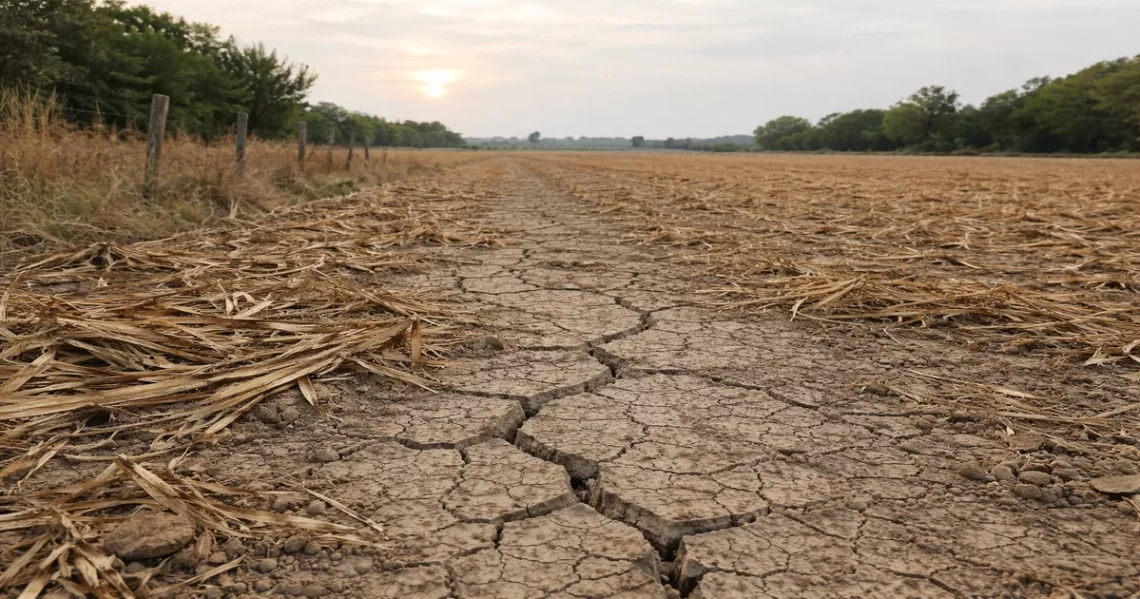
But lately, I’ve been paying closer attention to what’s happening beneath the surface. And what I’m seeing is a kind of quiet fatigue. Not dramatic. Not sudden. Just a slow wearing down. A land that has been asked to give and give and give, season after season, without enough time or care to rebuild what it has lost.
And when the land gets tired, everything built on top of it feels that tiredness too.
Soil isn’t just dirt — it’s a living system
Healthy soil is alive. It’s teeming with microbes, fungi, minerals, organic matter, and complex underground relationships that allow plants to pull real nourishment from the earth. When that system is intact, food carries vitality. It carries information. It carries the building blocks our bodies recognize and know how to use.
But when soil becomes overworked, stripped, compacted, chemically dependent, or monocropped year after year, that living system thins out. The soil still produces food, but the depth of nourishment quietly declines.
The tomato still looks like a tomato. The lettuce still fills the bin. But the invisible conversation between soil and plant has changed.
And that matters more than most people realize.
The hidden connection to immunity and energy
Our bodies are built from what we eat. Every cell, every enzyme, every immune response, every burst of energy traces back to nutrients extracted from the earth. When soil is depleted, food becomes less mineral-rich, less biologically complete, and harder for the body to fully utilize.
Over time, that can show up as:
Lower baseline energy
Weaker immune resilience
Slower recovery from stress or illness
A body that feels like it’s running on backup power
This isn’t about fear. It’s about awareness. When we talk about immunity and energy, we often jump straight to supplements, protocols, or the latest wellness trend. But the foundation starts much earlier — long before food reaches a plate.
It starts in the soil.
The ripple effect we rarely talk about
Modern agriculture has accomplished incredible scale. But scale often comes with shortcuts. Heavy tilling. Synthetic fertilizers. Pesticides. Herbicides. Crops pushed for yield rather than nourishment. Fields left without time to regenerate.
The result is a food system that can keep shelves full while quietly emptying the land.
And when the land is running on depletion, so are we.
You can see this living-soil foundation explored more deeply in The Soil Blueprint of Human Health, where nourishment begins long before a seed becomes food.
This theme of hidden environmental impacts on our bodies also connects with Why “Healthy” Homes Make Us Sick, where we explored how unseen foundations quietly shape our well-being.
This isn’t hopeless — it’s a turning point
Here’s the hopeful truth: soil can be rebuilt. Life returns when given the right conditions. Regenerative practices restore microbial diversity. Compost and cover crops replenish minerals. Reduced chemical inputs allow ecosystems to re-balance. Farmers all over the world are proving that land can recover.
And when soil recovers, so does the quality of our food. And when food regains vitality, bodies respond.
This is not about perfection. It’s about direction. Awareness. Supporting food systems that rebuild rather than extract. Asking where our food comes from. Valuing nutrient density over empty abundance.
Small shifts. Big ripples.
Listening to the land again
When we talk about health, we often look inward — at hormones, inflammation, gut balance, stress. All important. But sometimes the deeper answer is outward. To the land. To the soil. To the original source of every nutrient we depend on.
When the land gets tired, we feel it.
When the land is restored, we rise with it.
This is an invitation to see food differently. To honor the soil beneath every meal. To remember that our health and the earth’s health are not separate stories — they are the same story told at different scales.
With love and truth,
—Donna 💚
Sources & Further Reading
FAO (2021) – The State of the World’s Land and Water Resources for Food and Agriculture (SOLAW 2021)
https://openknowledge.fao.org/server/api/core/bitstreams/ecb51a59-ac4d-407a-80de-c7d6c3e15fcc/content
USDA Economic Research Service (2022) – Cover Crops Can Influence Soil Health
https://www.ers.usda.gov/amber-waves/2022/march/cover-crops-can-influence-soil-health-even-within-the-first-few-years-after-adoption/
Montgomery et al. (2022) – Soil health and nutrient density (PeerJ open-access)
https://peerj.com/articles/12848/
Rosier et al. (2025) – From soil to health: regenerative agriculture and nutrition outcomes (Frontiers in Nutrition)
https://www.frontiersin.org/journals/nutrition/articles/10.3389/fnut.2025.1638507/full
Bhardwaj (2024) – Decline in nutritional quality of foods (PMC open-access)
https://pmc.ncbi.nlm.nih.gov/articles/PMC10969708/