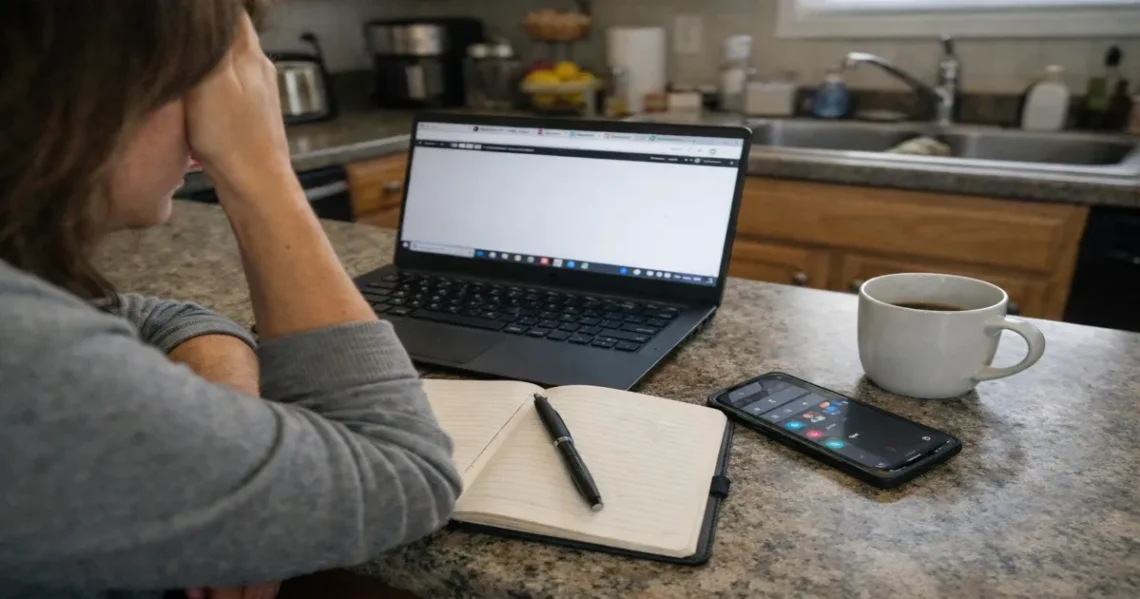
There is a quiet kind of exhaustion that does not come from doing too much. It comes from taking in too much. I cannot ignore how many people are walking around today feeling mentally scattered, emotionally drained, and unable to land on a single clear thought. You start your day with one intention, and within minutes you have absorbed headlines, opinions, warnings, hot takes, and contradictory advice coming from every direction. It is not that you are incapable of clarity. It is that your mind has been flooded beyond what it was meant to hold at one time.
I believe a lot of people are blaming themselves for something that is deeply environmental. When your brain is always reacting, always sorting, always scanning for what matters and what does not, it never gets the chance to settle. And when the mind never settles, confusion starts to feel normal. That does not mean it is healthy. It just means it has become common.
What information overload is really doing to your mind
Your brain was never designed to process this much input without pause. Every notification, article, video, text, comment thread, and expert opinion makes a demand on your attention, and each one leaves a little residue behind. Over time, that residue becomes mental clutter. Clarity requires space, but information overload crowds out that space before your thoughts have time to organize themselves.
I have seen how this creates a kind of internal noise that people begin to mistake for personal weakness. They think they have lost their focus, their discipline, or their ability to think for themselves. But often what has really happened is much simpler: they have been overexposed. Too much input creates mental fatigue, and mental fatigue makes even ordinary decisions feel heavier than they should.
Why too much input makes you doubt yourself
One of the most damaging effects of constant information is that it slowly chips away at your trust in your own thinking. When every opinion is immediately followed by ten more, your internal voice begins to feel quieter and less certain. You start looking outward for the answer, not because you have none, but because the noise around you makes your own clarity harder to hear.
I refuse to accept the idea that people suddenly became less thoughtful, less wise, or less capable. What changed was the environment around their thinking. When every instinct is interrupted by another opinion, another warning, or another “must-read” explanation, hesitation begins to replace discernment. That is how people end up frozen, second-guessing themselves, and waiting for one final outside voice to tell them what is true. We touched that same pattern in Why You’re Waiting for the Right Answer, because confusion often grows wherever self-trust begins to shrink.
Why confusion does not stay in your head
Mental overload does not stay neatly contained in the mind. It spills into the body. It shows up as irritability, restlessness, poor sleep, emotional fatigue, and that strange feeling of being “on” all the time without really being present. Your nervous system carries what your mind has not been given time to process.
I believe this is one reason so many people say they feel tired even when they have not done anything physical. Their energy has been drained by constant sorting, filtering, comparing, and reacting. That kind of invisible labor is still labor. And when it goes on day after day, the body begins to reflect the overload the mind has been trying to manage alone. That connects closely with Why You’re Tired Even After Sleeping, because exhaustion is often bigger than sleep. Sometimes it is the result of living in a state of constant internal processing.
How to start getting your clarity back
Clarity usually does not return because you found better information. It returns because you finally reduced the amount you were carrying. This is where many people get stuck. They try to fix overload by gathering more input, more podcasts, more articles, more experts, more research. But you cannot think your way out of overload by adding more to it.
Start by narrowing your inputs on purpose. Choose a small number of trusted sources instead of opening the door to every voice. Build in actual quiet. Step away from the stream long enough for your own thoughts to come back into focus. I have seen how quickly the mind begins to soften when it is no longer being bombarded every minute of the day. It may not happen all at once, but it does happen. Thoughts become less tangled. Decisions feel lighter. Your own sense of what is true begins to come back.
Most importantly, begin honoring your internal response again. Not every answer worth trusting arrives from the outside. Sometimes clarity returns the moment the noise stops dominating the room. You are not broken because you feel confused. You may simply be overloaded.
With love and truth,
—Donna 💚
Sources & Further Reading
1. Cognitive overload: Info paralysis
https://www.mayoclinichealthsystem.org/hometown-health/speaking-of-health/cognitive-overload
2. Media overload is hurting our mental health. Here are ways to manage headline stress
https://www.apa.org/monitor/2022/11/strain-media-overload
3. Information overload, cognitive fusion, and health literacy in the era of digital information: challenges and opportunities
https://pmc.ncbi.nlm.nih.gov/articles/PMC12859006/
4. Too much social media to sleep: the chained mediation effect of communication overload, information overload, information strain, and depressive symptoms between social media overload and insomnia
https://pmc.ncbi.nlm.nih.gov/articles/PMC11998352/
5. Redefining psychopathology in the context of digital overload
https://pmc.ncbi.nlm.nih.gov/articles/PMC12647004/