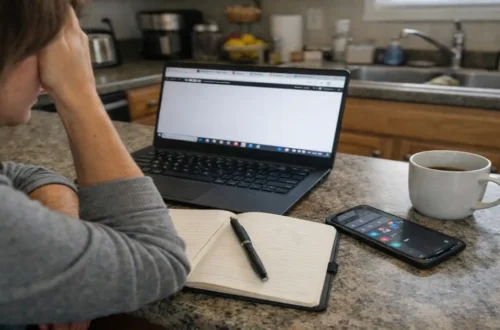
I think a lot of people are quietly exhausted from trying to be “informed.” Not lazy. Not careless. Not uninterested in their health. Exhausted. They’ve listened to the podcasts, watched the interviews, read the labels, followed the accounts, saved the articles, compared the opinions, and somehow still feel like they’re standing in the middle of the kitchen wondering, “Okay… but what am I actually supposed to do?” And I want to say this gently, because I know people are trying so hard: more information does not always create more power. Sometimes it creates more noise.
We were told that access to information would set us free, and in some ways, yes, it can. I believe truth matters. I believe learning matters. I believe asking questions matters deeply. But there is a difference between being informed and being flooded. When your mind is being hit all day long with warnings, contradictions, expert opinions, influencer opinions, “new studies,” old beliefs, fear-based headlines, and miracle solutions, your body does not always feel empowered. Sometimes your body feels threatened. Sometimes your nervous system starts treating every decision like a test you might fail.
Why More Information Can Make You Feel Less Empowered
There’s a point where research stops feeling helpful and starts feeling like a burden. You may have started out trying to make one better choice for your body, but then one question turned into twenty. Should I eat this? Avoid that? Try this supplement? Stop this habit? Trust this doctor? Question that study? Follow this protocol? And before you know it, the thing that was supposed to help you feel more steady has you feeling more unsure than when you began. That is not empowerment. That is overload dressed up as education.
I believe this is one of the traps of modern health culture. Everything is available, all the time, from every direction, and it all sounds urgent. Someone is always telling you that one food is saving your life while someone else says it is destroying you. One person says fasting is the answer. Another says fasting wrecked their hormones. One person tells you to detox. Another tells you detox is nonsense. And somewhere in the middle is a real human being with a real body, trying to make sense of it all while still cooking dinner, paying bills, sleeping poorly, and carrying stress they may not even have language for yet.
This is why I wrote about why so many people feel confused about their health, because confusion is not always a personal failure. Sometimes confusion is the predictable result of too many competing voices. When every message sounds certain, but the messages do not agree, you do not become more confident. You become more dependent on the next voice that promises clarity. And I refuse to believe that real health begins by making people feel like they can no longer trust their own common sense.
The Difference Between Learning and Spinning
Learning has a different feeling in the body than spinning. Real learning gives you something to work with. It may challenge you, but it also helps you see more clearly. It helps you ask better questions. It helps you notice patterns. It brings you closer to your own life, your own choices, your own body. Spinning does the opposite. Spinning makes you feel like you need one more video, one more article, one more expert, one more warning, one more confirmation before you are allowed to take even one small step.
And let’s be honest, many people are not actually looking for more information anymore. They are looking for relief. They want someone to finally say, “Here. This is the answer. You can stop searching now.” I understand that feeling. When you are tired, confused, or not feeling well, certainty becomes very attractive. But certainty is not the same thing as truth. Sometimes the loudest, most confident voice is simply the one with the best marketing, the strongest fear hook, or the cleanest little slogan.
I believe a healthier question is not, “Who sounds the most certain?” A healthier question is, “Does this information help me understand my body better, or does it make me more afraid of getting it wrong?” That question alone can change the way you take in information. Good guidance should not pull you farther away from yourself. It should help you become more grounded, more observant, and more capable of making a next right choice.
When Research Becomes Another Form of Stress
There is a point where constant researching becomes stress in disguise. You may think you are being responsible, and sometimes you are. But if every search leaves you more tense, more suspicious, more afraid to eat, more afraid to rest, more afraid to choose, then something has shifted. Your body is no longer receiving information as support. It is receiving information as pressure. And pressure has a cost.
This matters because the body does not separate “health research” from the rest of your stress load just because your intention is good. If you are scrolling late at night, comparing conflicting advice, reading scary claims, and trying to solve your entire life at midnight, your nervous system is involved in that experience. Your mind may call it research, but your body may experience it as danger. That is why you can close the laptop with more tightness in your chest, more tension in your stomach, and less confidence than when you opened it.
I am not saying stop learning. I am not saying ignore information. I am saying we have to become honest about what kind of information is actually helping us heal and what kind is keeping us stuck in a loop. If the information never turns into grounded action, it may not be wisdom yet. It may just be more mental clutter.
Your Body Needs Clarity, Not Constant Input
Your body does not need you to become an expert in every single health debate before you are allowed to care for it. It needs you to pay attention. It needs consistency. It needs less panic and more pattern recognition. It needs you to notice what gives you steadier energy, what disrupts your sleep, what foods leave you feeling nourished or drained, what routines support you, what environments agitate you, and what choices keep showing up as helpful over time.
That is why personalizing your health begins with listening to your own body. Not because outside information has no value, but because outside information was never meant to replace your own awareness. Your body is not a blank screen waiting for an influencer, an expert, or an algorithm to tell you what is happening. It is communicating every day. The question is whether the noise around you has gotten so loud that you can barely hear it anymore.
Start there. Not with ten new rules. Not with another full-body overhaul. Just start by asking, “What is my body showing me?” That one question is quieter than the internet, but it is often much more useful. Clarity usually comes from noticing cause and effect in your real life, not collecting endless theories you never get to test.
How to Start Filtering What Deserves Your Attention
One of the most practical things you can do is reduce the number of voices you allow into your decision-making. I know that sounds simple, but it is not always easy. We get used to checking everything. We get used to comparing everything. We get used to believing that if we do not listen to every warning, we might miss the one thing that could save us. But living that way keeps the nervous system on high alert, and a body on high alert has a hard time healing, discerning, or settling into anything with confidence.
Choose a smaller circle of inputs. Look for people and sources that respect nuance, admit complexity, avoid fear-based absolutes, and do not shame you for asking questions. Be cautious around anyone who turns every health topic into panic, purity, or a one-size-fits-all command. Be cautious around advice that makes you feel dependent on the next purchase, the next program, or the next secret. Truth does not need to hijack your nervous system to be useful.
Then give yourself permission to pause before reacting. You do not have to change your entire diet because of one post. You do not have to throw away everything in your pantry because of one headline. You do not have to adopt every new recommendation the moment it crosses your screen. You can slow down. You can compare it against your own patterns. You can ask whether it applies to your situation. That pause is not ignorance. That pause is discernment.
Simple Ways to Come Back to Your Own Signals
If you feel overloaded, start smaller than you think you should. Pick one area of your life to observe for a week. Maybe it is your sleep. Maybe it is your energy after meals. Maybe it is how you feel after being online for too long. Maybe it is how your body responds to stress, movement, hydration, or certain foods. Keep it simple enough that you will actually do it. You are not trying to build a perfect tracking system. You are trying to rebuild a relationship with your own body.
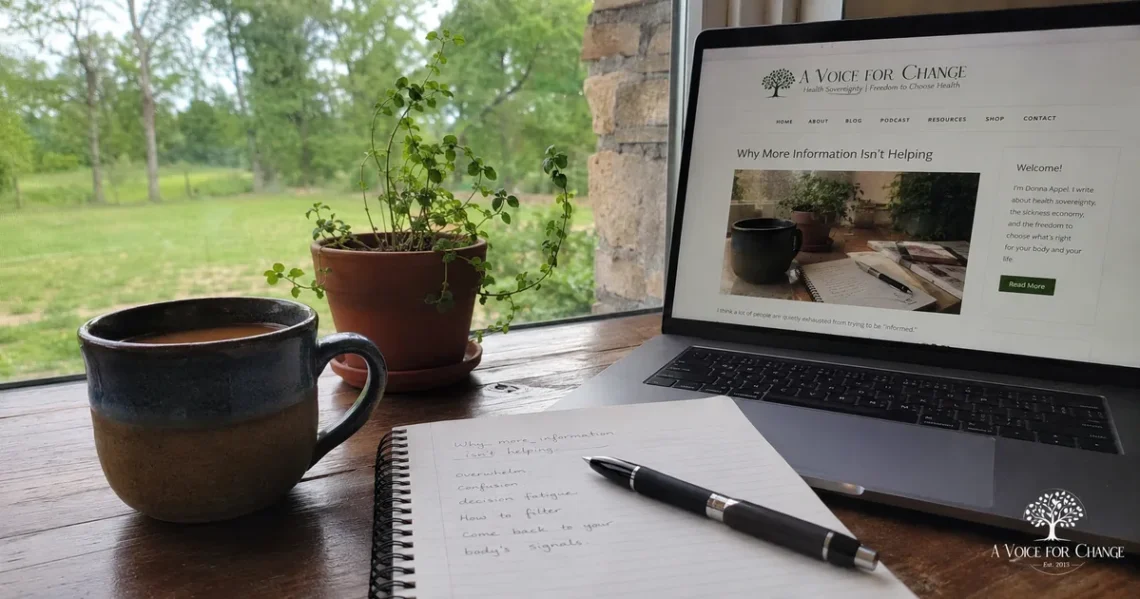
You might write down a few notes at the end of the day: what you ate, how you slept, what your energy felt like, what seemed to help, what seemed to drain you. Not obsessively. Not fearfully. Just honestly. Over time, patterns begin to show themselves. And once you see a pattern, you can make one small adjustment. Then you watch again. That is how trust comes back. Not all at once. Not through force. Through steady, grounded attention.
So if more information has not been helping you, I want you to hear this clearly: you are not behind. You are not failing because you cannot keep up with every health opinion flying around online. You may simply need less noise and more connection to what is already happening in your own body. You do not need to know everything to take the next honest step. You need enough clarity to begin, enough patience to observe, and enough trust in yourself to keep listening.
Next week, we’ll keep walking through this together as we look at why people often keep waiting for certainty before they act—and how that waiting can quietly keep them stuck.
With love and truth,
—Donna 💚
Sources & Further Reading
- Cognitive overload: Info paralysis
https://www.mayoclinichealthsystem.org/hometown-health/speaking-of-health/cognitive-overload - 8 Signs of Decision Fatigue and How To Cope
https://health.clevelandclinic.org/decision-fatigue - 6 Tips to Overcome Analysis Paralysis
https://health.clevelandclinic.org/analysis-paralysis - Dealing with information overload: a comprehensive review
https://www.frontiersin.org/journals/psychology/articles/10.3389/fpsyg.2023.1122200/full - How to reverse the alarming trend of health misinformation
https://www.apa.org/monitor/2024/07/ending-health-misinformation