There was a time when most people believed that if something was wrong, the system would catch it. The doctor would connect the dots. The specialist would talk to the other specialist. The records would follow you. The symptoms would be taken seriously. The treatment plan would make sense. The questions would be welcomed.
But more and more people are learning the hard way that being your own health advocate is no longer optional. It is becoming one of the most important survival skills a person can have.
That does not mean every doctor is bad. It does not mean every nurse is careless. It does not mean every test, prescription, or treatment is wrong. Many good people are working inside a system that is rushed, overwhelmed, fragmented, and built more around management than true healing.
But we have to be honest about where we are. The system is not designed to know your body better than you do. It is not designed to sit with your whole story. It is not designed to ask every deeper question. It is not designed to connect every symptom, every exposure, every medication, every stressor, every food choice, every environmental factor, and every past decision.
That work is falling back on you.
And I care enough to say this plainly: you cannot afford to be passive with your own health anymore.
The system sees pieces, but you live the whole story
Most people do not enter the healthcare system with one clean symptom and one easy answer. They enter with a history. They enter with fatigue, pain, brain fog, digestive issues, anxiety, sleep problems, hormones out of balance, inflammation, strange reactions, or symptoms that come and go.
But the system often separates the body into departments. One doctor handles one part. Another doctor handles another part. The chart may hold pieces of your story, but you are the only one living inside the whole thing.
That is why self-advocacy matters.
You know when something changed. You know when a medication made you feel worse. You know when a symptom started after an exposure, an illness, a shot, a stressful season, a moldy building, a food change, or a new prescription. You know when your body is whispering before it starts screaming.
And yet many people have been trained to dismiss themselves. They walk into appointments already afraid of sounding difficult. They soften their words. They minimize their symptoms. They leave with questions still stuck in their throat.
This is part of why so many people relate to the pain behind why you’re told it’s “all in your head”. When real symptoms are dismissed long enough, people start doubting their own reality.
That is dangerous.
Your body is not an inconvenience. Your questions are not a burden. Your concerns are not disrespectful. Your health belongs to you.
Advocacy is not rebellion. It is responsibility.
Somewhere along the way, asking questions started being treated like defiance. Wanting to understand risks became “hesitancy.” Wanting another opinion became “noncompliance.” Wanting to read the ingredients, the studies, the side effects, the warnings, or the records became “doing your own research” as if that were something shameful.
No. That is backwards.
A responsible person asks questions. A responsible parent asks questions. A responsible patient asks questions. A responsible citizen asks questions.
The Agency for Healthcare Research and Quality even has a patient campaign called “Questions Are the Answer,” reminding people that simple questions before, during, and after appointments can help them take better care of themselves. AHRQ also teaches shared decision-making, where patients and clinicians discuss benefits, harms, risks, options, and what matters most to the person receiving care.
So let’s stop pretending that blind trust is the gold standard.
Trust should be earned through clarity, honesty, respect, and informed choice. When someone cannot answer your questions, will not slow down, refuses to explain risks, or makes you feel foolish for wanting to understand, that is not patient-centered care. That is control wearing a white coat.
And again, this is not about attacking every provider. It is about waking people up to the reality that you are the one who has to live with the outcome.
Your records matter
One of the most practical forms of health advocacy is keeping your own records. Not just trusting that one portal will talk to another portal. Not assuming every doctor has every lab. Not assuming the specialist read the full history.
Get copies of your labs. Keep medication lists. Write down dates. Track symptoms. Save imaging reports. Know what was tested and what was not tested. Bring your own timeline when something complicated is going on.
Under HIPAA, patients generally have the right to inspect, review, and receive copies of their medical and billing records, with some exceptions. That matters because you cannot advocate well if you do not have access to the information being used to make decisions about your body.
This is especially important when symptoms are being managed but not solved. I have said before that the system often treats symptoms as separate events instead of messages from a body asking for help. That is why why symptoms get managed, not solved matters so much. If we do not track the whole pattern, the root picture gets missed.
Your records help you see patterns. They help you ask better questions. They help you catch mistakes. They help you avoid repeating the same failed path over and over again.
You need discernment, not fear
Being your own advocate does not mean believing everything you see online. It does not mean rejecting every conventional tool. It does not mean replacing wisdom with fear.
It means learning how to evaluate information carefully.
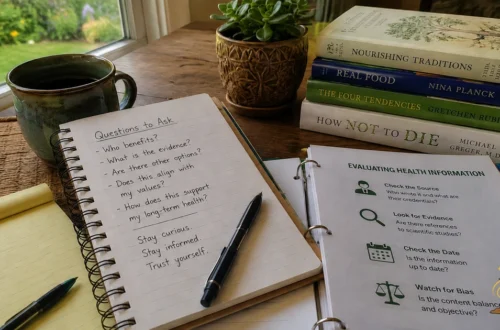
MedlinePlus, from the National Library of Medicine, tells people to ask who runs a health website, who funds it, where the information comes from, whether it is current, and whether it makes dramatic promises. That is good advice.
Discernment means you do not hand your mind over to fear-based marketing, but you also do not hand your body over to a system just because it has authority.
You look. You ask. You compare. You pause. You gather information. You talk with people you trust. You weigh the risks and benefits. You listen to your body.
And then you make the best decision you can with the information you have.
That is not reckless. That is mature.
What self-advocacy looks like in real life
Self-advocacy can be simple.
It looks like writing down your top three questions before an appointment so you do not forget them when the visit feels rushed. It looks like asking, “What else could this be?” It looks like asking, “What are the risks if I do this, and what are the risks if I don’t?” It looks like asking whether there are lifestyle, nutritional, environmental, or root-cause factors that should be considered.
It looks like saying, “I need that explained in plain language.” It looks like bringing someone with you when you are overwhelmed. It looks like asking for copies of labs and learning what they mean. It looks like getting a second opinion when something does not sit right.
It also looks like choosing better inputs every day. Better food. Cleaner products. More rest. Less toxic exposure where possible. Less fear. More truth. More responsibility.
We do not need people to become arrogant. We need people to become awake.
Because health freedom does not begin in a courtroom or a campaign slogan. It begins when a person says, “I am allowed to understand what is happening to my body.”
The old model is breaking
The old model told people to obey first and ask later. The old model told people symptoms were random, isolated, or imagined. The old model told people their bodies were complicated machines that only experts could understand.
But people are waking up.
They are realizing that chronic illness is not normal just because it is common. They are realizing that symptoms are information. They are realizing that food, stress, chemicals, medications, toxins, sleep, trauma, hormones, and environment all matter. They are realizing that no one has more at stake than they do.
This is not about rejecting help. It is about refusing to surrender your responsibility.
You can respect a doctor and still ask questions. You can use medicine and still want root causes. You can listen to experts and still listen to your body. You can be kind and still be firm.
That is what this moment requires.
Be respectful. Be prepared. Be honest. Be persistent. And do not let anyone shame you for wanting to understand the decisions being made about your life.
Because you are not just a patient.
You are a person.
And you are your own advocate now.
If this message speaks to you, share it with someone who needs permission to ask better questions, trust their body, and take a more active role in their own health. WE THE PEOPLE are stronger when we stop surrendering our discernment.
With love and truth,
—Donna 💚
Sources & Further Reading
- AHRQ — Questions Are the Answer
https://www.ahrq.gov/questions/index.html - AHRQ — The SHARE Approach
https://www.ahrq.gov/sdm/share-approach/index.html - HHS — Your Medical Records
https://www.hhs.gov/hipaa/for-individuals/medical-records/index.html - Healthy People 2030 — Health Literacy in Healthy People 2030
https://odphp.health.gov/healthypeople/priority-areas/health-literacy-healthy-people-2030 - MedlinePlus — Evaluating Health Information
https://medlineplus.gov/evaluatinghealthinformation.html