We have been taught to believe that paying more for grass-fed beef means we are getting something cleaner, healthier, and raised the way nature intended. We see green pastures on the package, read those reassuring words, and picture cattle spending their lives grazing freely on healthy land.
That is what most families believe they are paying for. They are trying to make a better choice for their health, support better farming, and avoid the industrial food system whenever they can. I respect that because those choices often require real effort and more money.
But here is the truth: the words “grass-fed” do not tell us nearly as much as we have been led to believe. They do not automatically tell us where the cattle were raised, how they were treated, whether they received antibiotics or hormones, how the pasture was managed, or whether that higher price is actually supporting an American farmer.
If a company is going to charge us more by creating the appearance of something better, then WE THE PEOPLE deserve to know exactly what “better” means.
Grass-Fed Tells Us About Feed—Not the Whole Life of the Animal
Under USDA guidance, a grass-fed claim is supposed to mean that cattle were fed grass and forage after weaning rather than grain or grain byproducts. They must also have access to pasture during the growing season. That is meaningful information, and I am not saying the claim has no value.
What I am saying is that it is only one part of a much larger story. Grass-fed is primarily a claim about what the animal ate. It is not a promise that the animal spent its entire life roaming a beautiful pasture. It does not guarantee regenerative grazing, humane treatment, American origin, organic feed, or freedom from antibiotics and added hormones.
Yet the packaging rarely makes those limitations clear. Instead, it gives us just enough information to create a comforting picture in our minds. That matters because our food choices shape the kind of farming we support. We cannot make informed choices when one attractive phrase is allowed to stand in for the whole truth.
Grass-Fed and Organic Are Not the Same
This is one of the biggest areas of confusion. Grass-fed beef is not automatically organic beef. The grass and forage may not have been grown under organic standards, and the grass-fed claim alone does not tell us whether antibiotics or added hormones were used.
If those things are important to your family, you have to look for additional information. That may include the USDA Organic seal, a trustworthy independent certification, or clear answers directly from the farmer or rancher.
Do you see what has happened? One word addresses feed. Another label addresses organic practices. Another claim may address antibiotics. Another may tell us where the animal came from. Meanwhile, an ordinary person standing in the grocery store is expected to understand this entire maze while trying to stay within a family budget.
That is not honest transparency. That is placing the burden on us to discover what food companies should have told us clearly in the first place.
A Picture of Green Pasture Proves Nothing
Grass and forage can include hay and other harvested forage brought to cattle when fresh pasture is unavailable. That can be perfectly reasonable, especially during winter or drought. But it is not always the endless pasture life many people imagine when they see “grass-fed” printed beside a photograph of rolling green fields.
The label also tells us nothing about the health of the land. Were the cattle moved regularly? Was the pasture allowed to rest and recover? Was the soil protected, or was the land overgrazed? Did the farmer encourage plant diversity and living roots, or were too many animals kept in one area for too long?
Simply putting cattle on grass does not make an operation regenerative. Good grazing requires observation, movement, timing, and respect for the land. As I explained in Regenerative Grazing: Why Animals Heal the Land, animals can play an incredible role in rebuilding soil—but only when the entire system is managed thoughtfully.
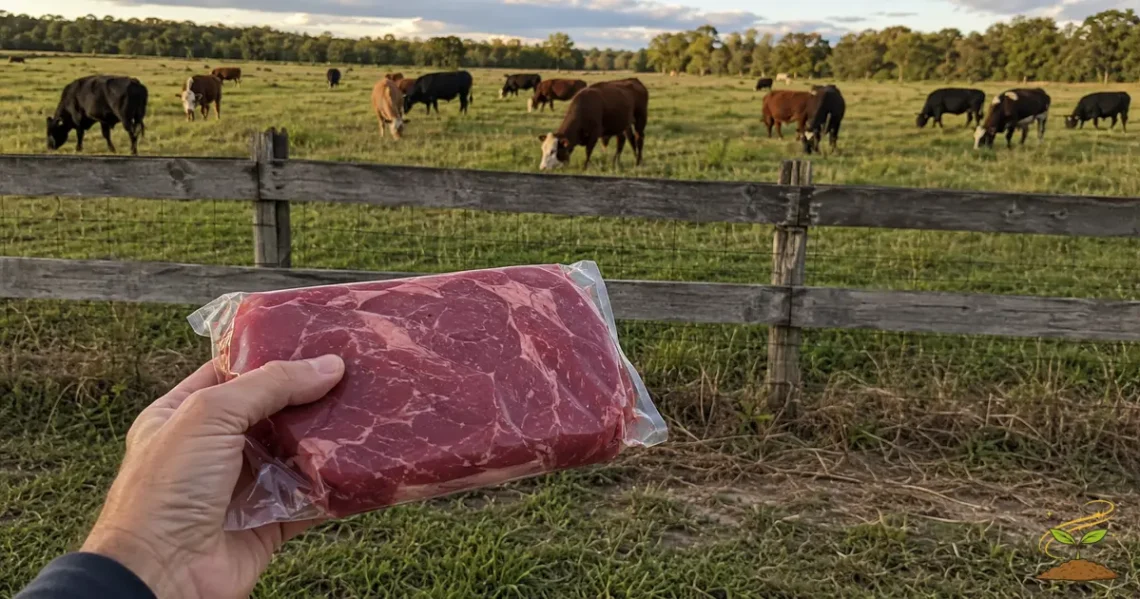
The picture on the package cannot show us any of that. It is there to sell a feeling, and we need to stop confusing that feeling with proof.
Grass-Fed Does Not Automatically Mean American
This may be the most important truth hidden behind the label. Grass-fed beef sold in an American grocery store does not automatically come from cattle raised by American farmers and ranchers.
As of January 1, 2026, meat using the voluntary claims “Product of USA” or “Made in the USA” must come from animals born, raised, slaughtered, and processed in the United States. That change gives consumers a more meaningful way to identify American meat—but only when that specific origin claim is present.
An American flag, a rustic barn, or a beautiful ranch scene is not the same as verified American origin. Neither is the name of an American company. If supporting our farmers matters to you, look beyond the design of the package. Look for a legitimate U.S.-origin claim, the name of the farm or ranch, or a certification that includes American origin in its standards.
Our farmers should never have to compete against imported beef dressed up to look as though it came from the ranch down the road. That is not fair to the farmer, and it is not fair to the family paying more because they believe they are buying American.
Look for Proof, Not Promises
A credible third-party certification can help fill in some of the blanks. The American Grassfed Association, for example, includes standards related to a forage-based diet, pasture access, traceability, American origin, antibiotics, and added hormones.
No certification is perfect, and no seal should stop us from asking questions. But published standards give us something real to examine. There is a great difference between a company placing an appealing claim on its own package and an independent organization verifying that specific requirements were met.
When you are paying a higher price, ask what you are actually paying for. Was the animal 100 percent grass-fed and grass-finished? Where was it born and raised? Did it receive grain at any point? Were antibiotics or added hormones used? Is the claim independently certified? Can the producer clearly explain how the cattle and land were managed?
If you have access to a local farmer, ask those questions directly. Farmers who are proud of their practices generally want people to understand how their food was raised. That honest connection is worth far more than a carefully designed package from a corporation that has no interest in telling us more than it is required to reveal.
This Is About Awareness, Not Perfection
I know not every family can purchase locally raised beef. Not everyone has a rancher nearby, and many people cannot afford the highest-priced meat in the store. This is not about shaming anyone for what they can or cannot buy.
It is about understanding that the food industry knows which words make us feel safe. It knows we want healthier food, humane treatment, clean land, and strong local farms. Those desires are used to sell products, even when the label delivers only a small part of what we believe we are buying.
Maybe you start by reading one package more carefully. Maybe you ask your grocery store where its beef comes from. Maybe you purchase directly from a farmer occasionally or buy a little less meat so you can choose a source you trust. Every informed choice matters.
We are not powerless consumers. Our money is building the food system every time we shop. When WE THE PEOPLE ask better questions and support farmers willing to give us honest answers, we make it harder for marketing to replace truth.
If this helped you understand what grass-fed beef labels leave out, please share it with someone trying to make better food choices. Families deserve the truth about what they are eating, and our farmers deserve honest labels that allow their real work to be seen.
With love and truth,
—Donna 💚
Sources & Further Reading
- Grass Fed, Grass Finished, Organic: What These Beef Labels Mean and More — Grass Run Farms
https://grassrunfarms.com/blog/grass-fed-vs-organic-beef-difference/ - Unveiling the Truth Behind Grassfed Labeling: Debunking Common Misconceptions — American Grassfed Association
https://www.americangrassfed.org/unveiling-the-truth-behind-grassfed-labeling-debunking-common-misconceptions/ - Product of USA Meat Labeling Changes in 2026 — Tyner Pond Farm
https://tynerpondfarm.com/blogs/all/product-of-usa-meat-labeling-2026 - Attention to the Details: How Variations in U.S. Grass-Fed Cattle-Feed Supplementation and Finishing Date Influence Human Health — Frontiers in Sustainable Food Systems
https://www.frontiersin.org/journals/sustainable-food-systems/articles/10.3389/fsufs.2022.851494/full - Availability of FSIS Guideline on Substantiating Animal-Raising or Environment-Related Labeling Claims — USDA Food Safety and Inspection Service
https://www.fsis.usda.gov/policy/federal-register-rulemaking/federal-register-notices/availability-fsis-guideline