There comes a point in your health journey when you have to ask a very honest question: when did you stop trusting yourself?
Not trusting every passing fear. Not trusting every internet headline. I mean trusting the quiet knowing inside you that says, “Something feels off,” or “This is helping,” or “This is too much,” or “I need to slow down and listen.”
That kind of trust matters. And I believe many people have lost it, not because they are weak or confused, but because they have been trained out of it.
We live in a world that constantly teaches people to outsource their own authority. Ask the expert. Follow the protocol. Buy the program. Take the pill. Wait for permission. Do not question too much. Do not listen too closely to your own body. Do not trust your own signals unless someone else validates them first.
That is not health independence. That is dependency dressed up as care.
And I want to say this clearly: you are allowed to trust yourself again.
Why We Stop Listening
Most people do not hand over their discernment all at once. It happens slowly.
You speak up about a symptom and get brushed off. You question a recommendation and feel dismissed. You follow advice that does not work for your body, then blame yourself when the results do not match what you were promised.
After enough of that, you start doubting your own instincts.
Maybe you felt worse after doing something that was supposed to be “healthy.” Maybe a food that works beautifully for someone else drains you. Maybe your body has been giving you signals for months, but every test comes back “normal,” so you start wondering if you are imagining things.
I have no doubt this is one of the most damaging parts of the modern sickness economy. It teaches people to ignore their own experience unless it fits neatly into someone else’s system.
But your lived experience matters. Your body’s response matters. Your observations matter.
That does not mean you reject all guidance. It means you stop abandoning yourself in the presence of guidance.
There is a difference.
This connects closely with what I wrote in Your Body Is Talking. Are You Listening?, because your body is communicating all the time. The question is whether you have enough quiet, confidence, and support to hear it.
Internal Authority Is Not Arrogance
Trusting yourself does not mean you know everything. It does not mean refusing help, ignoring wise counsel, or pretending research does not matter. That is not discernment. That is reaction.
Internal authority means you become an active participant in your own life again.
It means you ask better questions. You pay attention to patterns. You listen to your body instead of bulldozing over it. You notice what gives you energy and what steals it. You stop treating every outside opinion as more trustworthy than your own direct experience.
That kind of authority is not loud. It is grounded.
And it is desperately needed right now, because people are overwhelmed with health information. Some of it is valuable. Some of it is marketing. Some of it is fear. Some of it is incomplete. Some of it may be true for one person and completely wrong for another.
If you do not rebuild your own center, you will be tossed around by every new headline, every new influencer, every new supplement, every new warning, every new “must-do” list.
Health sovereignty begins when you stop letting every outside voice outrank the wisdom of your own body.
How Dependency Keeps You Unsure
Dependency systems work best when people stay uncertain.
If you are always unsure, you keep searching. If you keep searching, you keep buying. If you keep buying, someone profits from your confusion. That may sound blunt, but I cannot ignore how often people are kept in a loop of more tests, more products, more protocols, and more fear without ever being taught how to reconnect with themselves.
This does not mean every product is bad or every practitioner is wrong. Not at all. There are good people doing good work. There are tools that help. There are times when professional care is necessary and wise.
But no practitioner, product, or protocol should require you to disconnect from yourself.
The right support should help you become more aware, not less. More capable, not more dependent. More steady, not more afraid.
This is also why I keep coming back to simplicity. In You Don’t Need Another Protocol, I talked about how easy it is to get buried under too many steps, too many voices, and too much complexity. When everything becomes complicated, people stop trusting what they see right in front of them.
They stop asking, “How do I actually feel?”
They start asking, “What am I supposed to do next?”
That shift may seem small, but it is everything.
Start Small and Pay Attention
Trusting yourself again starts in very ordinary places.
It starts when you notice that your energy crashes every afternoon and you do not immediately shame yourself for being tired. You ask what your body might need. Better food rhythm? More protein? Less stress? More sleep? Less caffeine pushing you past your limits?
It starts when you realize a certain environment leaves you tense, drained, or overstimulated, and instead of pretending it is fine, you admit the truth.
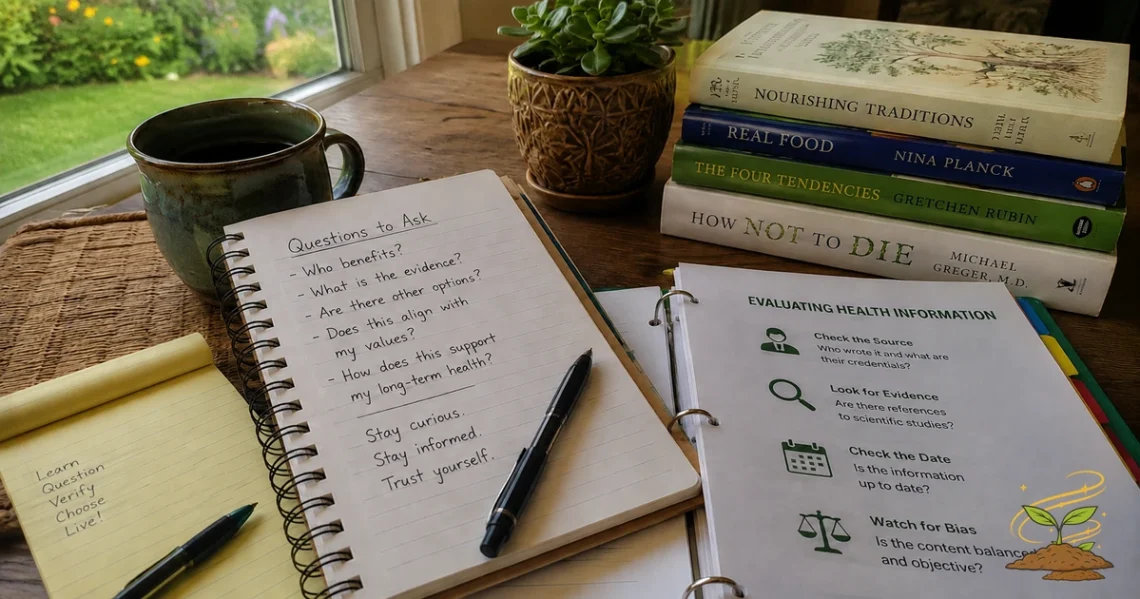
It starts when you pause before saying yes. When you read the label. When you ask who benefits from your fear. When you stop sharing health information just because it sounds urgent. When you ask, “Is this helping me become more grounded, or is it making me more afraid?”
Start small. Keep a simple record of what you notice. Not an obsessive tracking system. Just honest awareness.
What helps your sleep? What disrupts your digestion? What calms your nervous system? What makes you feel scattered? What gives you steady energy? What leaves you feeling worse, even if someone else swears by it?
Those patterns are not random. They are information.
You Can Be Informed Without Being Controlled
I want people informed. I want people reading, learning, questioning, and paying attention. But I also want people strong enough to stand in the middle of all that information without being controlled by it.
There is a difference between education and programming.
Education gives you tools. Programming gives you scripts. Education helps you ask better questions. Programming punishes you for questioning. Education strengthens your discernment. Programming makes you dependent on whoever is speaking the loudest.
We need more people who can say, “I will look at the information, but I will not abandon my own body in the process.”
That is where freedom begins in everyday life. Not as a slogan. Not as a political talking point. As a lived practice. One decision at a time. One boundary at a time. One honest observation at a time.
Because when you trust yourself again, you become harder to manipulate. You become harder to scare. You become harder to sell to. You become more capable of choosing what truly supports your health instead of chasing what keeps you dependent.
And that matters. For you. For your family. For this country. For every person who has been made to feel powerless in their own body.
You are not powerless.
You are not broken because you have questions.
You are not difficult because you want to understand.
You are not irresponsible because you want to participate in your own care.
You are rebuilding something the system should have never taken from you in the first place.
Trust yourself again. Start there. Then keep going.
If this message speaks to you, share it with someone who has been made to doubt their own body, their own instincts, or their own right to ask questions. We rebuild health freedom by helping one another remember what was always ours.
With love and truth,
—Donna 💚
Sources & Further Reading
- What Is Health Literacy? | CDC
https://www.cdc.gov/health-literacy/php/about/index.html - Health Literacy in Healthy People 2030 | Office of Disease Prevention and Health Promotion
https://odphp.health.gov/healthypeople/priority-areas/health-literacy-healthy-people-2030 - Evaluating Health Information | MedlinePlus / National Library of Medicine
https://medlineplus.gov/evaluatinghealthinformation.html - Know the Science: Finding and Evaluating Online Resources | NCCIH
https://www.nccih.nih.gov/health/know-science/finding-and-evaluating-online-resources - What Doctors Want Patients to Know About Decision Fatigue | American Medical Association
https://www.ama-assn.org/public-health/behavioral-health/what-doctors-want-patients-know-about-decision-fatigue