Sometimes the land tells the truth long before people are ready to hear it.
A field of one crop, stretched out as far as the eye can see, can look impressive from the road. It looks orderly. It looks efficient. It looks like progress. But nature has never been built on one thing repeated over and over again. Healthy land is not a factory floor. It is a living system, and living systems need relationship, movement, variety, and balance.
That is why monocropping and biodiversity matter so much. When we strip the land down to one crop, one pattern, one root system, and one repeated demand season after season, we are asking the soil to function without the very diversity that keeps it alive. For a while, the system may still produce. It may even produce a lot. But production is not the same thing as health.
And eventually, the land starts showing us the difference.
Monocropping Looks Efficient Until You Look Closer
Monocropping is the practice of growing the same crop, or one dominant crop, over and over on the same land. Corn after corn. Soybeans after soybeans. Wheat after wheat. From a business standpoint, I understand why it became so common. It simplifies equipment, planting, harvesting, storage, planning, and marketing. It fits the industrial mindset very well.
But the industrial mindset is not the same as the natural world.
Nature does not grow in straight lines of sameness. A healthy prairie, forest, pasture, or garden is full of different roots, different plants, different insects, different microbes, different fungi, different birds, and different relationships. Each piece does something. Some plants pull up minerals. Some cover the soil. Some feed pollinators. Some loosen compacted ground. Some protect against erosion. Some support the underground life we never see but absolutely depend on.
When we remove that diversity and replace it with one crop, the land loses options. It loses flexibility. It loses its ability to respond. And that matters because resilience is not built from sameness. Resilience is built from diversity.
I talked about this soil connection in Why Healthy Soil Grows Better Food, because food quality begins long before food reaches the plate. It begins in the soil, and soil is not just a growing medium. It is alive.
The Soil Gets Tired
One of the simplest ways to understand monocropping is this: the land is asked for the same thing again and again, while being given less and less variety in return.
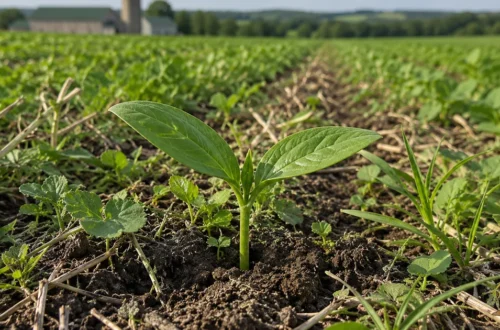
Different plants interact with soil in different ways. Their roots reach different depths. They feed different microbial communities. They use nutrients differently. They leave behind different residues. They create different habitat above and below the surface. When a farm has more plant diversity, the soil has more kinds of support.
But when the same crop dominates year after year, the soil system becomes narrower. The biological life beneath the surface can become less diverse. Nutrients can be depleted in predictable ways. Pest and disease pressures can build because the same food source is available over and over. The farmer may then need more fertilizer, more herbicide, more pesticide, more intervention, and more expense just to keep the system producing.
That is not resilience. That is dependency.
And I do not say that to blame farmers. Most farmers are working inside a system that rewards volume, speed, uniformity, and short-term yield. Many of them are under enormous financial pressure, and it is not fair to act like every farmer can simply step out of that pressure overnight. The real issue is the system that keeps pushing agriculture further away from the natural patterns that made land healthy in the first place.
Biodiversity Is Not Decoration
I think one of the mistakes we make is treating biodiversity like it is something extra. Something pretty. Something environmentalists talk about. Something nice to have if there is room for it.
But biodiversity is not decoration. Biodiversity is function.
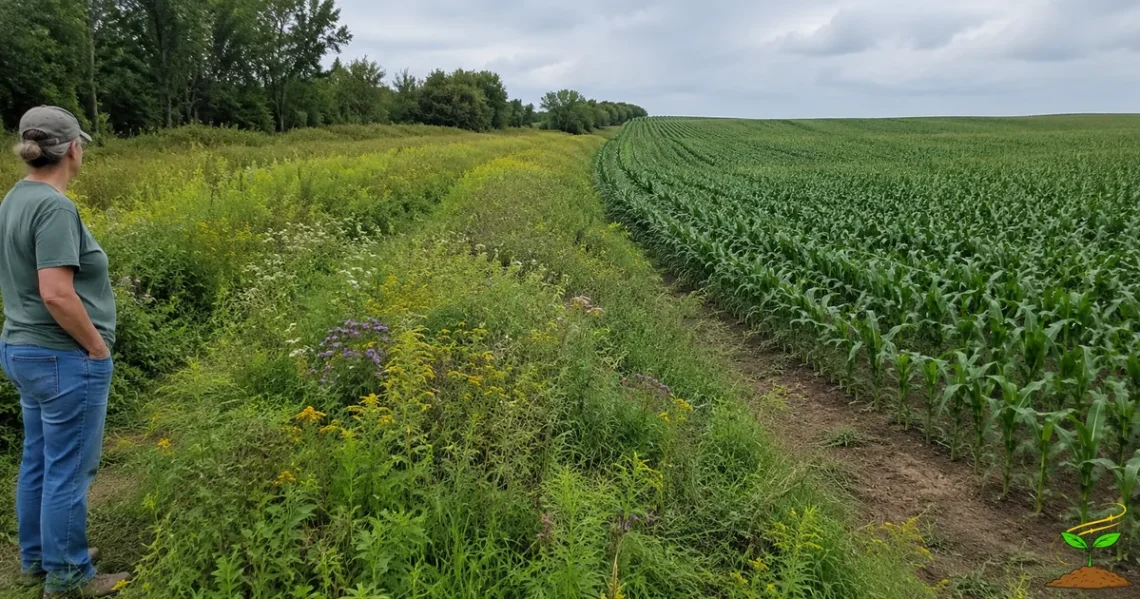
In a healthy farm system, diversity helps protect the land. It supports pollinators and beneficial insects. It feeds soil organisms. It helps interrupt pest cycles. It gives birds and insects a place to live. It keeps roots in the ground for more of the year. It helps the soil hold together when rain comes hard. It supports water movement, nutrient cycling, and recovery after stress.
When biodiversity disappears, the land may look neat, but it becomes more fragile.
That is the part people need to understand about monocropping and biodiversity. This is not just about whether a field looks green. It is about whether that field has enough life in it to keep functioning without being constantly propped up. A single crop may cover the ground for part of the year, but it does not replace the complexity of a living ecosystem.
The land does not need perfection. It needs relationship. It needs enough diversity to keep the system from collapsing into dependence.
Pests Love Sameness
One of the clearest problems with monocropping is pest pressure.
If a pest prefers a certain crop, and that crop is planted across a large area year after year, the pest has an open invitation. There is no real interruption. No confusion. No barrier of plant diversity. No healthy balance of other organisms keeping things in check the way a more complex ecosystem might.
That is how the cycle begins. More sameness leads to more pressure. More pressure leads to more chemical control. More chemical control can disrupt the very beneficial insects, soil organisms, and natural checks that might have helped restore balance. Then the system becomes even more dependent on outside inputs.
It is the same pattern we see in so many areas of modern life. We simplify something too far, break the natural balance, and then spend years trying to manage the consequences with more products, more control, and more intervention.
That is not how living systems thrive.
Resilience Comes From Relationship
A resilient farm is not one that never faces stress. Every farm faces stress. Weather changes. Rain comes too hard or not enough. Insects show up. Disease pressure happens. Markets shift. Costs rise. Farming has never been easy, and I never want to pretend it is.
But a resilient system has more ways to respond.
Crop rotation, cover crops, prairie strips, hedgerows, intercropping, compost, managed grazing, reduced disturbance, living roots, and keeping the soil covered are all examples of practices that can help bring more life and flexibility back to the land. Not every practice fits every farm, and that matters. Real stewardship has to be local. The land, climate, soil, equipment, animals, market, and farmer all matter.
But the principle is still the same: the more we work with living systems instead of against them, the more resilient the land can become.
I wrote about this in Regenerative Grazing: Why Animals Heal the Land, because animals, plants, soil, water, insects, and microbes were never meant to be treated as separate worlds. When those pieces are allowed to work together again, the land has a chance to rebuild.
This Is About Food, Too
It is easy to talk about monocropping as if it is only a farming issue. But it is also a food issue, a health issue, and a sovereignty issue.
When our food system depends heavily on a narrow group of crops, that affects what fills grocery store shelves. It affects processed food. It affects animal feed. It affects soil quality. It affects rural communities. It affects farmers’ choices. It affects what is affordable and what becomes harder to find.
And when the land is weakened, we cannot pretend the food is untouched by that.
I believe this is one of the reasons people feel so disconnected from food now. Food has become a product instead of a relationship. We see packages, labels, marketing claims, and prices, but we rarely see the field, the farmer, the soil, the seed, the rain, the inputs, or the long-term cost of producing food in a system that keeps demanding more from less.
That disconnection benefits the industrial food system. It does not benefit the people.
How We Start Moving Back Toward Resilience
Most of us are not deciding what gets planted on thousands of acres. But that does not mean we have no role. We can begin by paying attention and asking better questions.
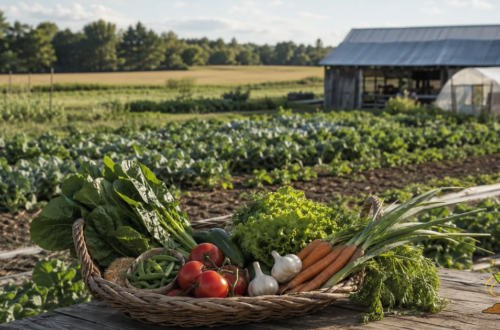
Where did this food come from? Was it grown in a system that builds soil or depletes it? Does the farm use crop rotation, cover crops, compost, managed grazing, or other practices that support biodiversity? Is there a local farmer nearby who is working to restore the land? Can I buy even one thing closer to the source this week?
We can also support the idea that farmers should not have to choose between surviving financially and caring for the land. That is a false choice created by a broken system. Farmers need markets, policies, and communities that reward stewardship instead of punishing it.
And in our own yards, gardens, and communities, we can remember that diversity matters there too. Plant flowers that feed pollinators. Leave some soil covered. Grow more than one thing. Compost when you can. Support living roots. Stop treating every insect as an enemy. Even small spaces can become little acts of restoration.
Monocropping fails because life was never meant to be reduced to one thing. The land needs variety. The soil needs life. The farm needs balance. The food system needs honesty. And people need to remember that resilience is not built by forcing nature into uniformity.
It is built by letting life work together again.
New here? You can explore more of my Farmland Friday reflections here: Farmland Friday
With love and truth,
—Donna 💚
Sources & Further Reading
- Soil Health — USDA Natural Resources Conservation Service
https://www.nrcs.usda.gov/conservation-basics/soil/soil-health - The Rise and Fall of Monoculture Farming — Horizon Magazine
https://projects.research-and-innovation.ec.europa.eu/en/horizon-magazine/rise-and-fall-monoculture-farming - Crop Diversification for Ensuring Sustainable Agriculture, Food Security, and Environmental Resilience — Global Challenges
https://onlinelibrary.wiley.com/doi/10.1002/gch2.202400267 - Beyond the Monoculture: Why We Need Biodiversity in Agriculture — University of Illinois Extension
https://extension.illinois.edu/blogs/field-notes/2024-07-24-beyond-monoculture-why-we-need-biodiversity-agriculture - Long-Term Agricultural Diversification Increases Financial Profitability, Biodiversity, and Ecosystem Services — Nature Communications
https://www.nature.com/articles/s41467-025-67757-7