I think one of the biggest mistakes we have made in modern agriculture is that we have learned to look at animals, soil, food, and health as if they are separate subjects, when in truth they were never meant to be separated at all.
For years, the conversation around animals and farming has been pushed into very narrow corners. We are often told that livestock is automatically harmful, that grazing always damages the land, and that animals are simply part of the problem. But when we slow down and look at the land itself, the story becomes much more honest and much more complete.
Animals can absolutely damage the land when they are crowded, confined, overused, or managed only for production. I will not pretend otherwise, because overgrazing and poor management are real problems. But animals can also help restore the land when they are placed back into a living system with movement, timing, rest, manure, roots, grasses, insects, birds, water, and soil all working together again.
That is why regenerative grazing matters. It is not about romanticizing livestock or pretending every grazing practice is good. It is about understanding that animals were always part of healthy ecosystems, and when they are managed with wisdom instead of extraction, they can become part of the healing process.
The Land Was Never Meant to Be Empty
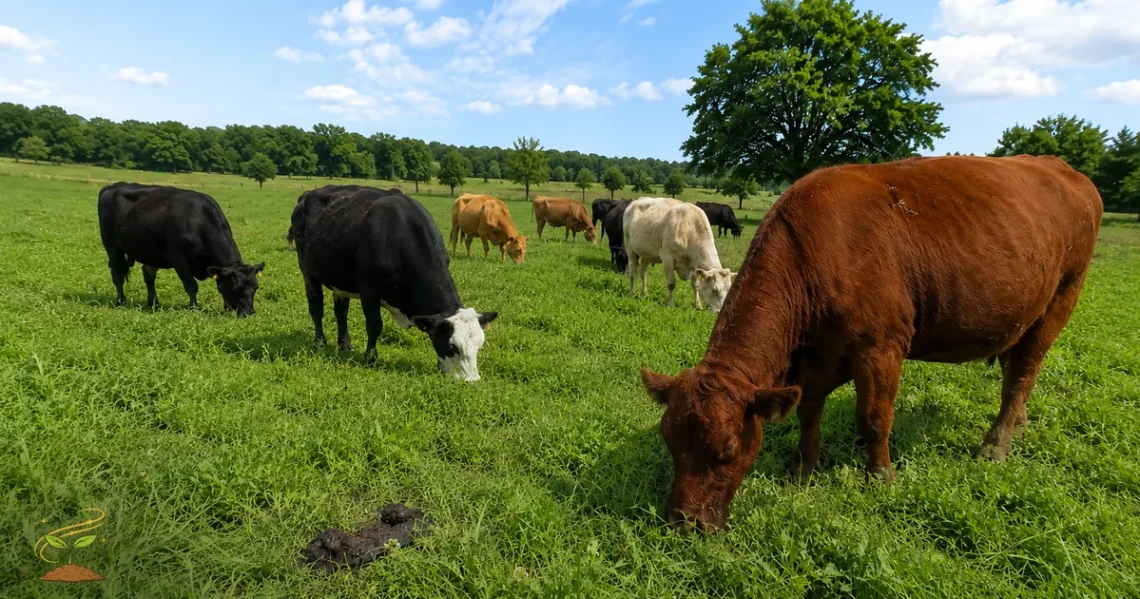
Grasslands were never meant to sit untouched like museum pieces, and they were certainly never meant to be stripped bare and treated like lifeless ground. Long before agriculture became industrialized, grazing animals moved across the land in patterns that gave the soil both pressure and recovery. They ate grasses, trampled plant material into the ground, fertilized the soil with manure, disturbed the surface just enough to encourage new growth, and then moved on so the land could rest.
That rest is the part we forget too easily.
Nature does not heal through constant taking. It heals through rhythm. There is growth, grazing, rest, and regrowth. There is disturbance, recovery, and renewal. When animals stay too long in one place, that rhythm is broken, and the land begins to show it. Plants are eaten down before they can recover, roots become weaker, soil is left exposed, and water runs across the surface instead of sinking down where it belongs.
But when grazing is managed carefully, animals can help restore some of the natural cycles that modern farming has interrupted. Their manure feeds soil life, their hooves press organic matter into the ground, and their grazing encourages grasses to grow back with stronger root systems when the land is given time to recover.
That is a very different picture from the one we are usually given.
Healthy Soil Needs Living Roots
If we want to understand why animals can matter so much to land restoration, we have to start below the surface, because the real story is not only in what we see above ground. Soil is not just dirt. Soil is alive, and it is full of bacteria, fungi, worms, insects, roots, moisture, minerals, and quiet relationships that most of us never see but all of us depend on.
Living roots feed that soil life. They help hold the ground together, support microbial activity, create pathways for water and air, and keep the land from becoming dry, compacted, and lifeless. When grasses are grazed properly and then allowed to recover, the plants respond by growing again, and that regrowth supports the underground life that makes healthy soil possible.
This is one of the reasons regenerative grazing is so different from the old extractive mindset. The goal is not to take everything a pasture can give until it is exhausted. The goal is to work with the pasture in a way that keeps it alive, covered, rooted, and rebuilding.
A healthy pasture is not just a field with animals on it. It is a living community, and when animals are managed with care, they are not separate from that community. They are part of it.
I wrote more about this connection in Why Healthy Soil Grows Better Food, because I believe we have to keep coming back to the truth that food quality begins long before anything reaches the plate. It begins in the soil, and the soil begins with how we treat the land.
Manure Is Not Waste When the System Is Healthy
One of the clearest signs that agriculture has been pushed out of balance is the way we talk about manure.
In a confined animal system, manure often becomes a waste problem. It piles up, it has to be stored, it can create pollution concerns, and it becomes something to manage as a burden because the animals have been separated from the land that was meant to receive it. That is not how a healthy system is supposed to work.
In a healthy grazing system, manure is not waste. It is fertility returning to the soil.
It brings nutrients back to the land, feeds microbial life, supports insects and decomposition, adds organic matter, and helps complete a cycle that should never have been broken in the first place. When animals are moved across pasture in a thoughtful way, their manure is spread across the land instead of concentrated in one place, and that makes an enormous difference.
This is why I believe the conversation around animals and agriculture needs more honesty. The problem is not simply the animal. The problem is often the system we have forced the animal into.
When animals are removed from the land, confined unnaturally, fed by crops grown somewhere else, and then blamed for the waste created by that separation, we are not looking at the whole picture. We are looking at the consequences of a broken system and calling the animal the problem.
That does not sit right with me.
Grazing Can Help the Land Hold Water
Healthy soil behaves very differently from depleted soil, especially when it rains.
When land is bare, compacted, or worn down, rain often runs across the surface instead of soaking into the ground. That means more erosion, more runoff, less moisture for plants, weaker pastures, and less resilience when dry weather comes. But when soil is covered with grasses, roots, and organic matter, it can act more like a sponge, holding water where it falls and making that moisture available to the life growing there.
Good grazing management can support that process by keeping plants growing, protecting the soil surface, and encouraging stronger root systems. This does not happen by accident, and it does not happen when animals are left too long on the same ground. It happens when farmers and ranchers are paying attention to the land, watching how it responds, and allowing enough rest for real recovery.
That matters more than most people realize, because water is one of the first places where land health shows itself. When water cannot enter the soil, the whole system becomes more fragile. Plants struggle, streams carry more sediment, drought hits harder, and the land loses its ability to recover.
We talk so much about food as if it begins in the grocery store, but food begins with land that can receive water, hold nutrients, grow strong plants, and support life above and below the surface.
The health of the land is not separate from the health of the people.
Animals Bring Balance When the System Allows It
There is a big difference between dominating the land and stewarding it.
Industrial agriculture often tries to dominate nature by separating everything into pieces. Animals are separated from pasture, crops are separated from animals, soil is separated from food, food is separated from health, and people are separated from the consequences of the system. Then we try to patch the broken pieces with chemical fertilizers, synthetic inputs, supplements, marketing claims, and complicated explanations that never quite get us back to wholeness.
Regenerative thinking asks a different question. What if the pieces were meant to work together?
Animals graze the plants. The plants regrow and feed the soil. Soil organisms break down organic matter. Water moves through the ground. Birds and insects return. Farmers observe, adjust, and work with the rhythm of the land instead of forcing it into exhaustion.
That does not mean every farm should look the same, and it does not mean every piece of land needs the same animals, the same timing, or the same grazing plan. Real stewardship is not one-size-fits-all, because land is living, local, and specific.
That is also why I talked about the difference between labels and practices in Organic vs Regenerative. A label can tell us part of the story, but practices show us how the land is actually being treated.
When it comes to animals, practices matter deeply. Are they rotated? Is the land rested? Is the soil covered? Are plants recovering? Is biodiversity returning? Is the farmer watching what the land is saying instead of forcing it to perform past its limits?
Those are the kinds of questions that help us see beyond slogans.
This Is Not About Romanticizing Farming
I do not want to make any of this sound easier than it is, because farming is hard, animals require daily care, weather can change everything, margins are tight, and many farmers are already carrying more pressure than most people understand.
So this is not about standing back and judging farmers who are trying to survive inside a food system that often works against them. It is about questioning the system itself, especially the way modern agriculture pushed farmers away from natural cycles and then expected them to produce more, faster, cheaper, and with less support.
When we demand cheap food, endless supply, perfect appearance, and disconnected convenience, we help create pressure on the land and the people working it. Then we act surprised when soil becomes depleted, small farms disappear, food feels less nourishing, and rural communities struggle.
These things are connected.
If we want healthier food, we have to care about healthier farms. If we want healthier farms, we have to care about healthier soil. And if we care about healthier soil, then we have to be willing to look honestly at the role animals can play when they are part of a balanced and thoughtful system.
How to Start Supporting Better Land Stewardship
Most of us are not moving cattle from one paddock to another or managing pasture recovery, but that does not mean we are powerless. We can begin by asking better questions and paying closer attention to where our food comes from.
Where was this food raised? Were the animals on pasture? Does the farmer talk about soil health, land rest, rotational grazing, biodiversity, or water retention? Is there a local farm nearby using regenerative grazing or managed grazing practices? Can I buy even one thing closer to the source, even if I cannot change everything at once?
That is how real change often begins. Not with perfection, but with awareness.
Animals are not automatically the enemy of the land. In the wrong system, they can absolutely contribute to damage, and we should be honest about that. But in the right system, with the right stewardship, they can help feed the soil, restore rhythm, support plant recovery, and bring life back to land that has been treated like a machine for far too long.
Maybe that is the bigger lesson in all of this.
Healing the land is not about removing every living piece from the system. It is about putting the pieces back into relationship again.
New here? You can explore more of my Farmland Friday reflections here: Farmland Friday
With love and truth,
—Donna 💚
Sources & Further Reading
- Soil Health — USDA Natural Resources Conservation Service
https://www.nrcs.usda.gov/conservation-basics/soil/soil-health - Grazing Management and Soil Health — USDA Natural Resources Conservation Service
https://www.nrcs.usda.gov/sites/default/files/2024-10/Grazing%20Management_SoilHealth.pdf - Managing Grazing to Restore Soil Health, Ecosystem Function, and Ecosystem Services — Frontiers in Sustainable Food Systems
https://www.frontiersin.org/journals/sustainable-food-systems/articles/10.3389/fsufs.2020.534187/full - Prescribed Grazing — Center for Rural Affairs
https://www.cfra.org/sites/default/files/publications/Prescribed%20Grazing%20WEB.pdf - Grasslands—More Important for Ecosystem Services Than You Might Think — Ecosphere
https://nora.nerc.ac.uk/id/eprint/522582/1/N522582JA.pdf